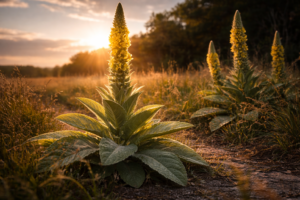
Here’s a question for you: what if one of the most powerful respiratory herbs on the planet was growing in the empty lot next to your house?
Because there’s a good chance it is.
Mullein (Verbascum thapsus) is literally a weed.
It sprouts up along roadsides, in ditches, across meadows, and in places most people wouldn’t look twice.
Fuzzy gray-green leaves, a tall stalk of yellow flowers, and zero respect from your average homeowner.
But here’s the thing, mullein herb benefits have exploded online.
We’re talking about 4.7 million related TikTok posts.
Search interest for “mullein tea” alone grew 81% in a single year.
Herbalists, functional medicine doctors, and everyday people trying to breathe better are all landing on the same plant.
So what does this “weed” actually do?
And why are so many people suddenly paying attention?
Let’s get into it.
What Is Mullein, Exactly?
Mullein belongs to the snapdragon family and is native to Europe, Asia, and North Africa.
It showed up in North America centuries ago, probably brought over as a medicinal herb, and it’s been spreading ever since.
There are over 300 species in the genus, but the one you’ll hear about most is Verbascum thapsus, commonly called common mullein or great mullein.
The plant is a biennial, meaning it takes two years to complete its life cycle.
First year: a low rosette of those signature soft, woolly leaves.
Second year: a tall flowering stalk that can shoot up to 5 or even 10 feet.
No kidding.
In Latin American communities, mullein goes by “gordolobo” and has been a household remedy for generations.
Native Americans used it too, they smoked the dried leaves and burned them as a respiratory aid.
Even Dioscorides, a physician for the Roman Army, recommended mullein for pulmonary diseases over 2,000 years ago.
This isn’t some newly discovered superfood.
It’s an herb with a resume that stretches back millennia.
The Mullein Herb Benefits Everyone’s Searching For
Alright, let’s talk about why mullein benefits are trending.
The core interest comes down to a few key areas, and there’s actual science behind most of them.
Mullein Lung Health: The Big One
This is the main reason people find mullein.
Mullein lung health support is what put this plant on the map, both historically and in modern search engines.
Here’s why it works: mullein contains saponins, which help break down and thin mucus, making it easier to cough up.
It also contains mucilage, a gel-like substance that coats and soothes irritated mucous membranes in your throat and airways.
A functional medicine specialist at Cleveland Clinic confirmed that mullein is helpful for any lung condition involving inflammation or infection.
Before antibiotics existed, it was a go-to herbal remedy for bronchitis, tuberculosis, and whooping cough.
These days, people reach for it more for colds, sore throats, coughs, and general respiratory comfort.
Plus, mullein acts as an expectorant, it doesn’t suppress your cough, it makes your cough more productive.
That’s a big distinction.
You want the gunk out, not trapped.
Anti-Inflammatory Properties
A 2013 study published in Revista Brasileira de Farmacognosia found significant anti-inflammatory effects from verbascoside, a compound isolated from mullein.
The researchers showed it could modulate inflammatory responses in human cells — the same mechanism that makes it useful for soothing irritated respiratory tissue and joints.
A separate review in PMC noted that mullein contains flavonoids like quercetin, luteolin, and kaempferol, all of which have well-documented anti-inflammatory activity.
So when people say mullein “calms things down,” there’s real biochemistry behind that claim.
Antibacterial and Antiviral Activity
This one surprised us.
Lab studies have found that mullein extracts show activity against Klebsiella pneumoniae (a bacteria linked to respiratory infections), Staphylococcus aureus, E. coli, and even certain viruses.
A 2023 study in the Journal of Ethnopharmacology documented antiviral activity against HCoV-229E (a human coronavirus), HSV-II, and Hepatitis B virus.
Now, these are lab findings, not human trials.
We want to be upfront about that.
But the direction of the research is consistent and growing.
And it lines up with centuries of traditional use.
Ear Infection Support
Here’s a lesser-known one: mullein oil (typically combined with garlic) has been traditionally used as a topical remedy for ear infections.
At least one preliminary study has shown promise in this area, though you’d want to be careful not to use it if you suspect a ruptured eardrum.
Why Mullein Tea Went Viral
Let’s talk about the elephant in the room.
Mullein tea didn’t just “get popular.”
It went absolutely viral.
TikTok is flooded with videos of people brewing mullein leaf tea and reporting dramatic results, clearing mucus, breathing easier, quitting nicotine faster, sleeping better.
Some of these videos have over a million likes.
The hashtag #mulleintea alone has millions of views.
And look, social media hype doesn’t equal scientific proof.
We know that.
But what’s interesting here is that the viral claims actually align with what traditional herbalists and modern researchers have been saying independently.
The expectorant and demulcent properties of mullein are well-documented.
People are filming themselves experiencing what the science already predicted.
The most common way to brew mullein tea: steep 1–2 teaspoons of dried mullein leaves in boiling water for 10 minutes, then strain.
The straining part is important, those fuzzy leaf hairs can irritate your throat if you don’t filter them out.
Bit ironic for a throat-soothing herb, but you get it.
Mullein Drops vs. Mullein Tincture vs. Tea: Which Format Works?

This is one of the most common questions we get.
Here’s the quick breakdown:
Mullein tea is the gentlest approach.
Great for daily use, easy to make, and the ritual of brewing it is honestly kind of relaxing on its own.
Best for mild respiratory support and general wellness.
Mullein tincture is an alcohol-based extract.
It’s more concentrated than tea and easier to take on the go.
Good for people who want a stronger dose without the brewing process.
Mullein drops, which is what we carry at 1Ness, are a liquid extract designed for convenience and potency.
You can add them to water, take them directly, or mix them into tea.
They deliver a concentrated dose of the bioactive compounds without requiring you to brew anything.
We actually wrote a full guide on this: Mullein Drops: Your Natural Guide to Better Breathing (2025 Guide).
If you’re someone who wants to integrate mullein into a daily routine without a lot of fuss, drops or tincture are probably your best bet.
If you enjoy the tea ritual and want something gentler, start there.
What to Watch Out For
Mullein is generally considered safe.
The FDA lists mullein leaves and flowers as GRAS (Generally Recognized As Safe), and there are no credible reports of major side effects from normal use.
That said, a couple things to keep in mind:
Mullein seeds contain rotenone, which is an insecticide.
It’s relatively safe in small amounts for humans, but it does mean you want to make sure your mullein products come from reputable sources that don’t have seed contamination.
Quality control matters here.
Pregnant or breastfeeding women should talk to a doctor before using mullein, mostly because there just isn’t enough safety data for those populations.
Same goes for young children, though a 2024 pediatric review found mullein to be safe and gentle for treating coughs and upper respiratory issues in kids when used appropriately.
And always, always, strain your mullein tea.
Those tiny leaf hairs will make you cough for all the wrong reasons.
Why the “Weed” Label Is Actually Part of the Story
Here’s what we love about mullein.
It doesn’t need a laboratory to exist. It doesn’t need a patent. And, it also doesn’t need a marketing budget.
It grows, everywhere, for free.
There’s something powerful about the fact that one of the most effective respiratory herbs known to herbalism is classified as a common weed.
It’s not rare & expensive. And, it’s not locked behind a prescription.
It’s literally growing in the cracks of a sidewalk somewhere near you right now.
That accessibility is the point.
Natural health shouldn’t be a luxury.
And mullein is proof that some of the most useful tools for your body are the ones nobody thought to put a price tag on, until now.
Ready to Try Mullein?

We carry a potent, organic mullein leaf extract designed specifically for respiratory support.
No fillers.
No shortcuts.
👉 Get our Mullein Leaf Extract for Healthy Lungs (4oz)
📩 Want special savings and 1Ness updates? Subscribe at www.be1ness.com
Mullein FAQ: Your Questions Answered
What are the main mullein herb benefits?
Mullein is best known for supporting respiratory health.
It acts as an expectorant (thins mucus) and a demulcent (soothes irritated membranes).
Research also shows anti-inflammatory, antibacterial, and antiviral properties.
It’s been used for lung health, sore throats, coughs, and ear infections for over 2,000 years.
Is mullein tea safe to drink every day?
For most healthy adults, yes.
Mullein leaves and flowers are listed as GRAS by the FDA.
Just make sure to strain your tea well to remove the tiny leaf hairs, which can irritate your throat.
If you’re pregnant, breastfeeding, or on medication, check with your doctor first.
Does mullein actually help your lungs?
The evidence is encouraging.
Mullein contains saponins that help break down mucus and mucilage that soothes airway tissue.
If you want a deeper breakdown of the active compounds and the research behind them, read our full guide on Mullein Leaf Extract: Benefits, Uses, and Scientific Insights.
A Cleveland Clinic functional medicine specialist confirmed that mullein is useful for lung conditions involving inflammation or infection.
Most evidence comes from traditional use and lab studies, human clinical trials are still limited.
What’s the difference between mullein drops and mullein tea?
Mullein tea is brewed from dried leaves and is the gentlest option for daily use.
Mullein drops are a concentrated liquid extract that delivers a more potent dose and is easier to take on the go.
Both deliver similar benefits, drops are just more concentrated and convenient.
Can mullein help you quit smoking?
Mullein won’t directly help you quit nicotine, but many people use mullein tea or drops to support their lungs during and after quitting.
Its expectorant properties help clear built-up mucus, and its soothing effects can ease the respiratory discomfort that often comes with quitting smoking.
If you’re actively trying to repair your lungs after smoking, our step-by-step guide on How to Detox Your Lungs Naturally After Years of Smoking breaks it down clearly.
Is mullein really just a weed?
Technically, yes.
Mullein (Verbascum thapsus) grows wild across North America, Europe, and Asia, on roadsides, in meadows, and in empty lots.
But it’s a weed with over 2,000 years of documented medicinal use and a growing body of modern scientific research behind it.
Where can I buy quality mullein products?
1Ness carries an organic mullein leaf extract at onenessdrops.com.
We also have a full guide to mullein drops here.