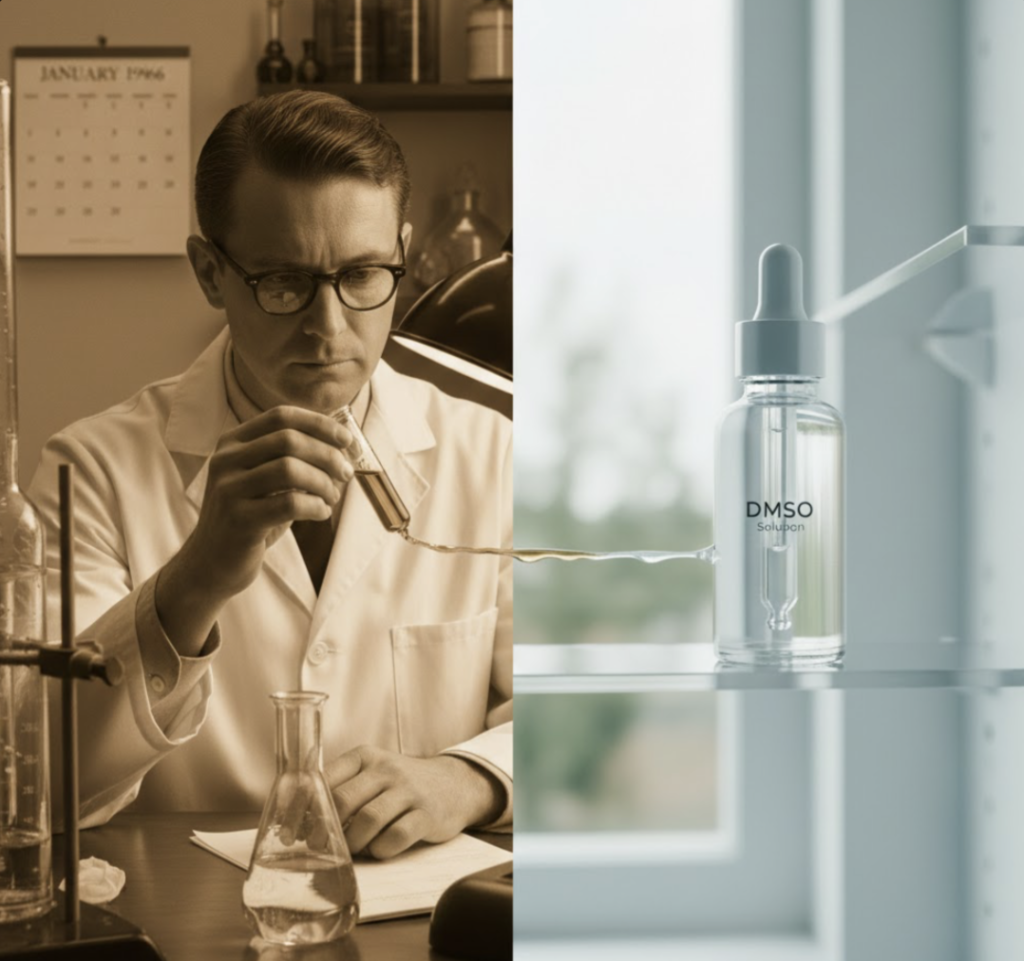
The strange story of DMSO history starts in a paper mill, takes a detour through the FDA, and somehow ends up in every horse barn in America. If that sounds like the setup for a conspiracy theory, well — it kind of is. And kind of isn’t.
Dimethyl sulfoxide, or DMSO, has one of the wildest journeys of any compound in modern medicine. It was nearly approved as a miracle drug in the 1960s. Then it got shut down overnight. Horses kept using it. People went underground. And now, decades later, it’s making a quiet comeback.
Here’s the real DMSO history they didn’t tell you — and why purity matters more than ever if you’re going to use it.
What Even Is DMSO?
Let’s start simple. DMSO stands for dimethyl sulfoxide. It’s a colorless, slightly oily liquid with a distinct smell — kind of garlicky, kind of sulfurous. You’ll know it when you smell it.
What makes DMSO unusual is its ability to penetrate skin and biological membranes almost instantly. Within minutes of touching your skin, you can actually taste it in your mouth. That’s not a myth — it’s chemistry. DMSO passes through tissue barriers like almost nothing else can.
This property made scientists very, very interested. Because if DMSO can carry itself through skin that easily, what else could it carry?
The Accidental Discovery: Paper Mills and a Strange Solvent
The DMSO story begins in 1866, when Russian chemist Alexander Zaytsev first synthesized the compound. He published his findings in a German journal in 1867 — and then, basically, nothing happened. For nearly 80 years, DMSO sat in obscurity as an industrial byproduct.
See, DMSO is created during wood pulp processing. Paper mills produce it as a waste product. For decades, it was just another solvent — useful for dissolving things, but nothing special.
That changed in the 1950s when industrial chemists started noticing something strange. Workers handling DMSO reported a weird garlicky taste in their mouths, even though they hadn’t ingested anything. The compound was somehow passing through their skin and into their bloodstream.
That quirk caught the attention of a surgeon in Oregon who was about to change everything.
Dr. Stanley Jacob and the Golden Age of DMSO Research
In 1962, Dr. Stanley Jacob was working at the University of Oregon Medical School (now Oregon Health & Science University). His focus? Organ transplantation. Specifically, he wanted to find better ways to preserve kidneys for transplant by freezing them without causing ice damage. He came across a British paper describing compounds that could protect red blood cells during freezing. One of them was DMSO. Jacob tracked some down and started experimenting. Then he accidentally spilled some on his skin.
Within minutes, he noticed a strange taste in his mouth — like oysters, he later said. No pain. No irritation. Just this weird, immediate absorption. Jacob was fascinated. He teamed up with chemist Robert Herschler, and together they began exploring what else DMSO could do. What they found was remarkable. DMSO wasn’t just a solvent. It was anti-inflammatory. It could carry other medications directly through the skin and into tissues. It seemed to relieve pain. It reduced swelling. And it appeared to be incredibly safe — even at high doses.
By 1963, Jacob was publishing papers calling DMSO “a new therapeutic principle.” The scientific community went wild. Six major pharmaceutical companies — including Merck, Squibb, and Syntex — jumped in to run clinical trials. The New York Times ran a front-page story calling it “the nearest thing to a wonder drug the nineteen-sixties have produced.” Over 100,000 people used DMSO before it was even officially approved. Professional athletes endorsed it. Movie stars used it. The momentum was unstoppable. Until it wasn’t.
The FDA Shutdown: What Happened?
In November 1965, everything changed. A woman in Ireland died after using DMSO to treat a sprained wrist. She’d also taken several other medications, and no autopsy was performed to determine the actual cause of death. But the press reported it as a DMSO death anyway.
Around the same time, some laboratory animals given extremely high doses of DMSO — far beyond what any human would use — showed changes in the lenses of their eyes.
That was enough. The FDA’s medical director sent out telegrams to every researcher in America: DMSO testing was suspended immediately. The agency also contacted the World Health Organization and U.S. embassies worldwide, warning that DMSO could cause blindness.
Just like that, the golden age of DMSO history was over.
Here’s the thing, though. At the time of the ban, over 100,000 people had already used DMSO — including 37,000 in formal clinical trials. Not a single case of eye damage had been reported in humans. The animal studies used doses many times higher than any therapeutic application.
Dr. Jacob and other researchers were stunned. They had no evidence of eye problems in their patients. But the pharmaceutical companies, despite having invested heavily in DMSO, quickly backed down. Nobody wanted to fight the FDA in the shadow of the thalidomide disaster that had just shaken the medical world.
The ban on general DMSO research wasn’t lifted until 1979 — fourteen years later. By then, interest had largely died. The momentum was gone.
Why Horses Got DMSO and Humans Didn’t
Here’s where the DMSO story gets absurd.
While human use was effectively banned, veterinary use continued. In 1970, DMSO was approved by the FDA for topical use in horses. It became a staple in every barn across America — a go-to treatment for inflammation, swelling, bowed tendons, and soft tissue injuries.
Today, DMSO is standard equipment in equine medicine. Veterinarians use it topically, orally, and intravenously. They treat everything from laminitis to neurological conditions to blister beetle poisoning. The compound that was supposedly too dangerous for humans became completely routine for horses.
The irony isn’t lost on anyone who knows the DMSO history. A racehorse can get DMSO for a swollen tendon, but a human with the same injury? That’s been a regulatory gray zone for decades.
In 1978, the FDA finally approved one human use: treating interstitial cystitis, a painful bladder condition. That approval opened a small door. Doctors can now legally prescribe DMSO and use it at their discretion for other conditions. But the compound never recovered its momentum from the 1960s.
The Underground Movement: People Kept Using It Anyway
Here’s what the FDA didn’t anticipate: people didn’t stop using DMSO just because it wasn’t approved.
Throughout the 1970s, 80s, and beyond, DMSO spread through word of mouth. You could buy industrial-grade DMSO at hardware stores and chemical supply companies. It was cheap. It was available. And people who’d experienced relief from pain and inflammation weren’t about to give it up because of regulatory politics.
The problem? Industrial DMSO isn’t made for human use. It can contain contaminants — residues from manufacturing, impurities that have no business touching your skin, let alone passing through it into your bloodstream.
Remember, DMSO carries whatever it touches directly into your body. If there’s dirt on your skin, DMSO can carry it in. If there are contaminants in the product itself, same thing. Using impure DMSO is like opening a direct pipeline from the outside world into your tissues.
This is where the underground DMSO movement hit a wall. People were getting results, but they were also taking risks they didn’t fully understand.
Why DMSO Purity Matters More Than Ever
If you’re going to use DMSO, purity isn’t a nice-to-have. It’s everything.
Pharmaceutical-grade DMSO is refined to 99.995% purity. That number isn’t marketing — it’s the difference between a clean compound and one carrying unknown contaminants straight through your skin.
Industrial-grade DMSO, the kind you might find at a hardware store, isn’t held to those standards. It’s made for dissolving things, not for therapeutic use. The trace impurities that don’t matter when you’re cleaning equipment can absolutely matter when the solvent is passing into your body.
Think about it this way: DMSO is one of the most powerful penetration enhancers known to science. It doesn’t discriminate. Whatever is in or on the product goes along for the ride. That’s why using pharmaceutical-grade DMSO from a trusted source isn’t optional — it’s the whole point.
The Bottom Line: History Repeats
The DMSO history follows a pattern we’ve seen before. A promising compound emerges. It gains momentum. Regulatory forces shut it down — sometimes for legitimate reasons, sometimes not. The mainstream forgets about it. And a dedicated group of people keeps using it anyway, passing knowledge through underground channels.
Decades later, interest resurfaces. New research validates what users knew all along. And suddenly everyone’s asking, “Why didn’t we know about this sooner?”
We’re in that resurgence phase now. DMSO never went away — it just went quiet. And as more people take responsibility for their own health decisions, compounds like this are getting a second look.
The lesson? Question the narrative. Do your own research. And if you decide something works for you, make sure you’re using it safely. That means pharmaceutical-grade purity, clean application, and understanding what you’re putting on (and into) your body.
For more on how DMSO differs from conventional pain relief options, check out our deep dive: The Hidden Problem With Modern Pain Relief — And Why DMSO Is Different.
FAQ — DMSO History and Purity
What is DMSO made from?
DMSO (dimethyl sulfoxide) was first synthesized in 1866 as a byproduct of wood pulp processing in paper mills. It’s derived from lignin, a natural compound found in trees. Today, pharmaceutical-grade DMSO is highly refined to remove impurities.
Why was DMSO banned for human use?
In 1965, the FDA halted clinical trials after animal studies showed potential eye changes at very high doses and an unrelated death was attributed to the compound. No eye damage was ever documented in humans, but the ban effectively killed mainstream research for over a decade.
What is pharmaceutical grade DMSO?
Pharmaceutical-grade DMSO is refined to 99.995% purity, free from the industrial contaminants found in hardware store or solvent-grade versions. This level of purity is essential because DMSO carries whatever it contacts directly through your skin.
Is DMSO safe?
DMSO has been used by hundreds of thousands of people and is FDA-approved for interstitial cystitis and veterinary use. The most common side effects are a garlic-like taste and minor skin irritation. However, because DMSO penetrates so effectively, purity and clean application are critical.
Why does DMSO purity matter?
DMSO is one of the most powerful skin-penetrating compounds known. It carries whatever it touches — including contaminants — directly into your bloodstream. Industrial-grade DMSO may contain impurities that are harmless in other applications but problematic when they enter your body.
Source References
- Wikipedia: Dimethyl sulfoxide — https://en.wikipedia.org/wiki/Dimethyl_sulfoxide
- Wikipedia: Stanley Jacob — https://en.wikipedia.org/wiki/Stanley_Jacob
- OHSU Digital Collections: Interview with Dr. Stanley Jacob — https://digitalcollections.ohsu.edu/record/3229
- McGill University Office for Science and Society — https://www.mcgill.ca/oss/article/medical-critical-thinking-history/dmso-not-cure-all-fdas-panic-over-it-birthed-myth
- TIME Magazine Archive: “Medicine: Blackout on DMSO” — https://time.com/archive/6834499/medicine-blackout-on-dmso/
- Equus Magazine: “7 Things You May Not Have Known About DMSO Use in Horses” — https://equusmagazine.com/diseases/seven-things-about-dmso